

posted 9th November 2026
Social value in central government procurement is about to change again. PPN 002 only arrived in February 2025, and from 1 January 2027 new central government tenders worth £1m or more will be scored under a different model, set out in PPN 026.
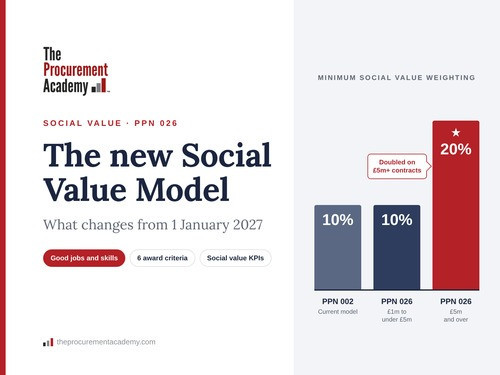
This time the change goes further. The model has been cut back to two things: jobs and skills. On contracts of £5m or more, social value gets a minimum weighting of 20%, and at least one social value KPI should be set and published.
As a CIPS training provider, we’ve been through the note and the Cabinet Office’s new guidance in detail. Here’s our plain-English take on what they say and what we’d be doing now if we were in your shoes.
What is PPN 026?
PPN 026 is a Procurement Policy Note from the Cabinet Office. It sets out the Social Value Model that central government bodies use to score social value when they evaluate tenders under the Procurement Act 2023. You’ll sometimes see it written as PPN 26. It’s the same note.
It also gives social value a new definition for central government contracts: “taking account of how a supplier will work for our communities to provide good British jobs, skills and opportunities in every postcode”.
The note applies to central government departments, their executive agencies and non-departmental public bodies. In scope are their covered procurements (those above the relevant public contract threshold under the Procurement Act 2023) worth £1m or more including VAT, where the tender notice is published on or after 1 January 2027. Private utilities contracts and contracts whose main purpose is overseas delivery, such as work for embassies, are left out.
Local councils, NHS trusts and universities aren’t covered, although the PPN says other public sector contracting authorities may wish to adopt the approach.
The note itself is six pages. On 28 October 2026 the Cabinet Office added a 32-page guide on using it, which sets out the full model with sub-criteria, standard reporting metrics and a suggested scoring method. You’ll find both on GOV.UK.
The six PPN 026 award criteria
PPN 002 gave buyers 17 award criteria to choose from, grouped under eight policy outcomes. PPN 026 has six, under two outcomes. Buyers choose the criteria that are relevant to the contract, and the guidance tells them to select the minimum number of criteria and sub-criteria needed to achieve the outcome they want.
Outcome 1: Good jobs
- 1a Create and/or retain high quality jobs: keeping or creating jobs in the area, including in high-growth sectors, and recruiting in ways that help communities get and keep work.
- 1b Fair working conditions: going beyond the statutory minimum, for example through flexible working or access to trade union representation, and helping people facing barriers to stay in work.
- 1c Fair pay: paying above the statutory minimum wage, with pay policies that reward and keep staff.
Outcome 2: Skills
- 2a Training and retraining: training that tackles skills shortages or supports people facing barriers to work. The PPN gives apprenticeships, work placements and workplace adaptations as examples.
- 2b In-work progression: helping the contract workforce move into better-paid work through new skills and retraining.
- 2c Talent pipeline: opening up routes into work through pre-work training, placements and apprenticeships, particularly for young people and communities facing deprivation.
The model is aimed at people who find it hardest to get into work. The PPN named four target groups, and the guidance now lists eight:
- young people aged 16 to 24 who aren’t in employment, education or training (NEETs)
- people who have left education or training in the previous 12 months
- people with a long-term health condition or disability
- people with special educational needs and disabilities (SEND) or neurodiversity
- care leavers aged 16 to 24
- people on probation, including those serving community sentences and prison leavers, and people in prison where support is aimed at reducing reoffending
- victims of domestic abuse
- veterans
What changes on 1 January 2027
In short, fewer things count, what counts carries more weight on big contracts, and delivery becomes much more visible. Here’s how the two models compare.
| PPN 002 (current model) | PPN 026 (from 1 January 2027) | |
|---|---|---|
| Structure | 5 missions, 8 policy outcomes, 17 award criteria | 2 outcomes, 6 award criteria |
| What counts | Jobs and skills, plus areas such as the environment, supply chain diversity, workforce wellbeing and modern slavery | Good jobs and skills. Criteria on things like carbon emissions or modern slavery can still be used, but outside the social value weighting |
| Contracts in scope | Covered procurements, which start at £135,018 inc VAT for central government goods and services | Covered procurements of £1m or more inc VAT |
| Minimum weighting | 10% | 10% from £1m to under £5m, and 20% from £5m |
| Monitoring | Commitments reflected in the contract as terms, KPIs or performance indicators | Commitments monitored through the contract, and at least one published social value KPI expected on contracts of £5m or more |
One detail is easy to miss. Where a buyer scores bids with an absolute method such as Price per Quality Point or a value for money index, the 10% or 20% applies to the quality score rather than the total.
The KPI rule is the one we’d pay most attention to. On contracts of £5m or more, PPN 026 says at least one social value KPI should be set. That’s on top of the KPIs the Procurement Act 2023 already requires on most contracts worth more than £5m. It should be published and reported on at least once every 12 months, so how well a supplier delivers on its social value promises should become a matter of public record. Buyers are also encouraged to set a social value KPI on smaller contracts where it’s appropriate.
There’s a sting in the tail, too. The PPN says evidence of poor performance against social value KPIs can be taken into account when deciding whether there are grounds to exclude a supplier from future tenders. The guidance says that in exceptional circumstances buyers should remind suppliers of this. Exclusion is at the buyer’s discretion, and comes after a supplier has been given a proper opportunity to improve and failed to do so, where the problem is continuing or likely to happen again.
When does it all happen?
The PPN was published on 5 August 2026, and the Cabinet Office followed it with detailed guidance on 28 October 2026. The guidance fills in most of the gaps, including sub-criteria for each award criterion, standard reporting metrics and the longer list of target groups. The one piece still to come is a List of Community Programmes that bidders can choose to support, which the guidance says will be published in the future.
The new model applies to procurements that start on or after 1 January 2027, and a procurement starts when its tender notice is published. For procurements that start before then, central government bodies are encouraged to move to PPN 026 early, but can stay with PPN 002 where switching would need disproportionate resources or undo market engagement they’ve already done. So for a while you’ll see both models in live tenders.
What PPN 026 means for buyers
On paper, the buyer’s job gets simpler. Six criteria are easier to work with than 17. In practice the hard part hasn’t changed: choosing something that genuinely fits the contract, scoring it fairly and making sure it’s delivered.
Start with the contract itself. Award criteria still have to relate to the subject matter of the contract and be proportionate, as section 23 of the Procurement Act 2023 requires. The right social value question for a facilities management contract won’t be the right one for a specialist consultancy. The PPN also asks you to research the market first, including whether SMEs, VCSEs or international suppliers are likely to bid, so the criteria you choose don’t shut anyone out.
The “British jobs” message has limits, too. The guidance reminds buyers that section 90 of the Procurement Act 2023 prohibits discrimination against treaty-state suppliers. If a bidder plans to deliver social value through a subcontractor, for example, you can’t require that subcontractor to be a UK supplier.
When it comes to scoring, the guidance says you should not score the quantity of what a supplier commits to. Assessment should stay qualitative, looking at how well the supplier’s method and implementation plan will deliver, and the guidance includes a suggested scoring template with scores of 0, 1, 3, 6 and 10. On contracts of £5m or more you can choose, case by case, to also score quantitative commitments under criterion 1a, such as the number of jobs or apprenticeships created, but the guidance says you must take legal advice first.
If you’re setting up a framework, think about social value now. You don’t have to apply the minimum weightings when you award the framework itself, but you must include some form of social value assessment at that stage if you want to evaluate social value at call-off. For call-offs from frameworks procured before 1 January 2027, you may need to follow the PPN that applied when the framework was awarded.
Bring your contract managers in early as well. The PPN expects every social value commitment to be monitored through the contract, with KPIs passed to contract managers. Once the List of Community Programmes is published, you should review it and include the programmes relevant to your contract, and if a supplier offers to support one, the KPI should track its delivery.
The PPN also expects commercial, procurement and contract management staff to be trained to apply it. Scoring very different jobs and skills offers consistently is harder than it looks, so it’s worth taking seriously.
What about the environment and the other themes that have dropped out? The guidance confirms you can still use criteria on things like carbon emissions or modern slavery, as set out in other PPNs, but they sit outside the 10% or 20% social value weighting rather than counting towards it.
If you work for a council, an NHS trust or a university, PPN 026 isn’t mandatory for you and it doesn’t change your existing legal duties. Some buyers outside central government may still borrow the new approach, so it’s worth knowing either way.
What PPN 026 means for suppliers
If you bid for central government work, the stakes are higher. On contracts of £5m or more, social value carries a minimum weighting of 20%, and what you commit to can end up in a published KPI.
Start by looking at what you already do. Environmental commitments no longer count towards the social value score in central government tenders, and the guidance says social value shouldn’t be delivered in the form of financial donations. Some familiar activities do carry over in a narrower form: the guidance lists increasing the number of SMEs, scale-ups and VCSEs in the supply chain under criterion 1a, and workplace health and wellbeing support under 1b. Pull together the evidence you have against each of the six criteria.
Next, think about additionality. The guidance says social value should be additional to the core contract. You can expand something you already do, but only if you can show the expansion is a direct result of winning that contract.
Then put your effort into the plan rather than the numbers. As a rule, buyers are told not to score the quantity of what you commit to, so a big headline figure won’t carry an answer on its own. A specific plan aimed at the target groups, that shows how you’ll deliver it, is far more likely to score well.
When the List of Community Programmes arrives, supporting one of its programmes will be optional. The guidance says a bid that does, evidences it with a dated letter and meets all the implementation criteria in the model question should receive a minimum score of 6 on its suggested scoring template.
Be realistic about what you promise. Your commitments go into the contract, and on larger contracts a commitment that helps you win can become a KPI that the buyer assesses and publishes at least once every 12 months. Work out now how you’ll collect the data, including from any subcontractors who’ll be doing the work.
Don’t drop the rest of your social value work either. Councils, NHS trusts and housing associations aren’t bound by PPN 026, and their tenders can still cover environmental and community themes.
How to prepare for PPN 026 before January
Whether you buy or bid, this is what we’d do now.
- Read the PPN and the guidance. Annex B of the guidance sets out the full model your tenders will be scored against, with sub-criteria and standard reporting metrics.
- Map what you do now against the six criteria. Be honest about where you have strong evidence, where you have activity but no data, and where there are gaps.
- Check which model applies to each live or upcoming procurement. The tender notice date decides it, so a tender published in December may still use PPN 002.
- Agree how you’ll measure delivery: what you’ll count, who collects it and how often. Using the guidance’s standard reporting metrics will save work later.
- Look out for the List of Community Programmes, and check whether any of them fit what you deliver.
- Invest in skills, both your team’s ability to apply the model and the training and apprenticeship opportunities you can offer through your contracts.
Why skills are the real story
Half of the new model is about skills, and the PPN is unusually direct about what it wants to see. Apprenticeships, work placements and workplace adaptations are named as examples, and the talent pipeline criterion even says that “45 days of work experience is exactly the kind of social value the Prime Minister is seeking to see delivered through this policy”.
As a training provider, we think that’s the most significant part of the change. Training is moving much closer to the centre of how public contracts are won.
For suppliers, an apprenticeship is one of the most straightforward social value commitments to evidence. It follows a recognised national standard, has a set structure and is formally assessed. The guidance’s own reporting metrics count apprenticeships created or retained under the contract, including those at Level 4 and above. The Level 4 Procurement and Supply Chain Practitioner apprenticeship, for example, includes the CIPS Level 4 Diploma in Procurement and Supply. Depending on the criteria a buyer chooses, a new apprenticeship linked to the contract could support commitments on creating jobs (1a) or the talent pipeline (2c), which is where the guidance’s apprenticeship metrics sit.
For buyers, applying PPN 026 well comes down to core procurement skills: writing a proportionate question, evaluating answers consistently and managing performance over the life of a contract. That’s the kind of ground CIPS qualifications cover, from sourcing and contracting to supplier relationships.
If you’d like to build that capability in your team before January, through CIPS qualifications or our skills training, or talk about apprenticeships as part of your social value offer, get in touch with The Procurement Academy.
PPN 026 FAQs
When does PPN 026 come into force?
It applies to covered central government procurements of £1m or more, including VAT, whose tender notice is published on or after 1 January 2027. For procurements that start before then, central government bodies are encouraged to switch early but can stay on PPN 002 where switching would need disproportionate resources or undo market engagement.
Does PPN 026 apply to local authorities and the NHS?
Not to local authorities or NHS trusts. It applies to central government departments, their executive agencies and non-departmental public bodies. Other public sector buyers can choose to adopt it.
What is the minimum social value weighting under PPN 026?
At least 10% for contracts from £1m up to £5m, and at least 20% for contracts of £5m or more, including VAT. Where a buyer uses Price per Quality Point or a value for money index, the percentage applies to the quality score.
What are the six PPN 026 award criteria?
Create and/or retain high quality jobs, fair working conditions, fair pay, training and retraining, in-work progression, and talent pipeline.
Who are the PPN 026 target cohorts?
The guidance lists eight: NEETs aged 16 to 24, people who have left education or training in the previous 12 months, people with a long-term health condition or disability, people with SEND or neurodiversity, care leavers aged 16 to 24, people on probation (including prison leavers, and people in prison where support is aimed at reducing reoffending), victims of domestic abuse, and veterans.
How are PPN 026 social value bids scored?
On quality rather than quantity. The guidance tells buyers not to score the quantity of what a supplier commits to, but how well its method and implementation plan will deliver, and it suggests a scoring template with scores of 0, 1, 3, 6 and 10. On contracts of £5m or more, buyers can choose, case by case, to also score quantitative commitments under criterion 1a, after taking legal advice.
What happens if a supplier misses a social value KPI?
On contracts of £5m or more, at least one social value KPI should be set, published and reported on at least once a year. Evidence of poor performance against social value KPIs can be taken into account when deciding whether there are grounds to exclude a supplier from future tenders. Exclusion is at the buyer’s discretion, after the supplier has had a proper opportunity to improve and failed to do so.
Do works contracts get the 20% weighting?
Standalone works contracts usually will. A works contract only comes into scope once it reaches the public contract threshold for works, currently £5,193,000 including VAT, so it will normally fall into the 20% band and should have a social value KPI. Frameworks are different. The minimum weightings don’t have to be applied when the framework itself is awarded, but it should let buyers evaluate social value at call-off, for example with a 20% weighting for call-offs of £5m and above. Call-offs under frameworks procured before 1 January 2027 may need to follow the earlier PPN.
Has the PPN 026 guidance been published?
Yes. The Cabinet Office published Guidance on using PPN 026 on 28 October 2026. It includes the full model with sub-criteria, standard reporting metrics, a suggested scoring method and eight target groups. A List of Community Programmes is due to follow.
Are PPN 26 and PPN 026 the same thing?
Yes. PPN 026 is the official reference, and PPN 26 is a shorthand you’ll sometimes see.
