

posted 27th October 2026
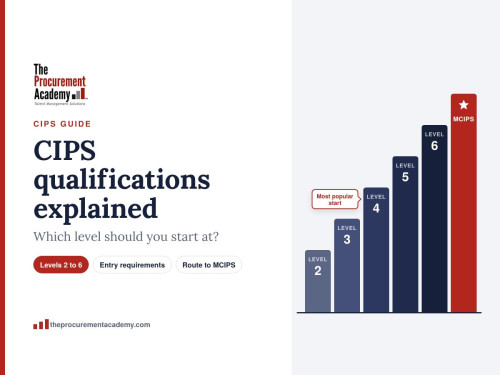
CIPS qualifications are the recognised professional standard for people who work in procurement and supply. There are five levels, from the Level 2 Certificate up to the Level 6 Professional Diploma, and together they lead to MCIPS Chartered status.
The question we're asked most often is where to start. The answer depends on your experience, not your job title. This guide explains what each level covers, how long it takes and which one is right for you.
What is a CIPS qualification?
CIPS is the Chartered Institute of Procurement & Supply, the professional body for procurement and supply. Its qualifications are regulated by Ofqual in England, Wales and Northern Ireland, and are formally recognised in several other countries.
Each level is made up of modules, and each module has its own computer-based exam. You pass every module at a level to achieve that qualification. To sit the exams, you join CIPS as a student member.
The five CIPS levels at a glance
- Level 2 Certificate in Procurement and Supply Operations: 5 modules, 18 credits, about 180 hours of study. A short introduction for people new to the profession.
- Level 3 Advanced Certificate in Procurement and Supply Operations: 5 modules, 30 credits, about 300 hours. For people in operational and support roles.
- Level 4 Diploma in Procurement and Supply: 8 modules, 60 credits, about 600 hours. At the same level as the first year of a degree, and the most popular starting point.
- Level 5 Advanced Diploma in Procurement and Supply: 8 modules, 60 credits, about 600 hours. At the same level as the second year of a degree.
- Level 6 Professional Diploma in Procurement and Supply: 7 modules, 60 credits, about 600 hours. CIPS describes it as equivalent to an honours degree, and it's the qualification that leads to MCIPS.
Which CIPS level should you start at?
You can start at Level 2, 3 or 4. Level 4 is the highest entry point, and it's where most of our learners begin. Here's a simple way to decide.
- New to procurement, with little business experience: start at Level 3. It has no formal entry requirements and covers the procurement environment, ethics, contract administration and working in teams. Level 2 is also available as a shorter introduction.
- In an operational or support role, such as purchasing assistant, contracts administrator or stock controller: Level 3 gives you a strong foundation and leads straight into Level 4.
- Two or more years' experience in a business environment, or two A levels: start at Level 4. You don't need Level 2 or 3 first. Typical roles include buyer, procurement officer, contracting officer and supply chain analyst.
- Already hold Level 4: move on to Level 5, then Level 6.
- An employer developing new procurement staff: look at our Level 4 Procurement Practitioner Apprenticeship.
If you have a relevant degree or another professional qualification, you may be able to claim exemptions from some modules. We can check this with you before you enrol.
What you'll study at each level
CIPS Level 3 Advanced Certificate
Four core modules: Procurement and Supply Environments, Ethical Procurement and Supply, Contract Administration, and Team Dynamics and Change. You then choose one elective: Socially Responsible Procurement or Socially Responsible Warehousing and Distribution. CIPS suggests allowing up to 12 months, and passing all five modules also earns 16 UCAS tariff points.
We teach Level 3 by tutor-supported distance learning, so you can start at any time and study around your job. Study CIPS Level 3 with us
CIPS Level 4 Diploma
Eight compulsory modules that follow the procurement cycle, from defining business need through contracting, negotiation and supplier relationships to L4M8 Procurement and Supply in Practice. CIPS suggests about 12 months.
Read our full guide to CIPS Level 4 for each module, the exam formats and how much study time to plan for.
CIPS Level 5 Advanced Diploma
Five core modules: Managing Teams and Individuals, Managing Supply Chain Risk, Managing Contractual Risk, Advanced Contract and Financial Management, and Managing Ethical Procurement and Supply. You then choose three electives from Category Management, Achieving Competitive Advantage Through the Supply Chain, Project and Change Management, Operations Management, Logistics Management and Advanced Negotiation.
CIPS suggests 12 to 15 months. Completing Level 5 makes you an Associate Member of CIPS.
CIPS Level 6 Professional Diploma
Four core modules: Strategic Ethical Leadership, Global Commercial Strategy, Global Strategic Supply Chain Management, and Future Strategic Challenges of the Profession. You then choose three electives from Strategic Programme Leadership, Commercial Data Management, Innovation in Procurement and Supply, Supply Network Design, Global Logistics Strategy, and the new Environmental, Social and Governance (ESG) Principles module.
CIPS suggests 12 to 15 months.
How CIPS exams work
Every module has its own computer-based exam, in one of two formats. Objective Response exams are multiple choice, with a pass mark of 70%. Constructed Response exams are written, essay-style answers, with a pass mark of 50%.
You can sit exams at a CIPS venue or remotely with an online invigilator, and you book each exam when you're ready for it.
From Level 6 to MCIPS Chartered status
MCIPS is the globally recognised standard for procurement and supply professionals. Once you've completed the Level 6 Professional Diploma and have three years' relevant experience, you can apply to become MCIPS. You'll also need an up-to-date CIPS Ethics Certificate.
If you follow CIPS's suggested timings, studying from Level 4 to Level 6 takes about three to four years. Your experience builds up over the same period, so many people apply for MCIPS soon after finishing Level 6.
Studying CIPS with The Procurement Academy
We're a CIPS Approved Study Centre, rated Good by Ofsted, and we deliver CIPS from Level 3 to Level 6. All of our CIPS tutors are FCIPS or MCIPS Chartered, so you learn from people who have been through the same route. Many of our learners start at Level 4 and stay with us all the way to Level 6.
- Classroom, online or distance learning: classroom groups in Leeds, Nottingham and Doncaster, depending on the level, live online from anywhere, or distance learning for Level 3. We're also opening a new Level 6 group in Nottingham.
- Flexible start dates: four a year for Levels 4 to 6 (January, March, June and September), and any time for Level 3.
- Strong results: our learners have achieved a 95% pass rate in an exam series, and some cohorts have reached 100%.
Not sure which level is right for you? Tell us about your role and experience and we'll recommend where to start. Our next Level 4 to 6 intake begins in January 2027, and you can start Level 3 at any time.
CIPS qualification FAQs
What is a CIPS qualification equivalent to?
CIPS says Level 4 is at the same level as the first year of an undergraduate degree, Level 5 the second year, and Level 6 an honours degree. Level 3 carries 16 UCAS tariff points.
Can I start CIPS at Level 4?
Yes, if you have two A levels, the CIPS Level 3 Advanced Certificate, or at least two years' relevant experience in a business environment. Level 4 is the highest level you can start at.
How long does it take to get MCIPS?
Following CIPS's suggested timings, Levels 4 to 6 take about three to four years. You also need three years' relevant experience, which you can build up while you study.
How do I register with CIPS?
You join CIPS online as a student member before you book your exams. When you study with us, we guide you through it.
Do I need a CIPS qualification to work in procurement?
No, but many procurement roles ask for CIPS qualifications or MCIPS, especially at more senior levels.
Are CIPS qualifications recognised outside the UK?
Yes. As well as being regulated in the UK, CIPS qualifications are formally recognised in countries including Dubai, Bahrain, Botswana, Ghana and Trinidad and Tobago.
